Defining Emergency Management: Is FEMA Moving Backwards?
In 2007, I was invited by Dr. Wayne Blanchard to participate in a working group consisting of experienced emergency management practitioners and well-respected academic researchers. The purpose of our group was to develop principles of emergency management. Dr. Blanchard noted in his opening remarks that while numerous books, articles and papers referred to “principles of emergency management”, nowhere in the vast array of literature on the subject was there an agreed upon definition of what these principles were.
One of the first obstacles we had to overcome was that there was also no agreed upon definition of emergency management, so we decided to tackle this problem first. After much discussion, we came to agreement on the following definition:
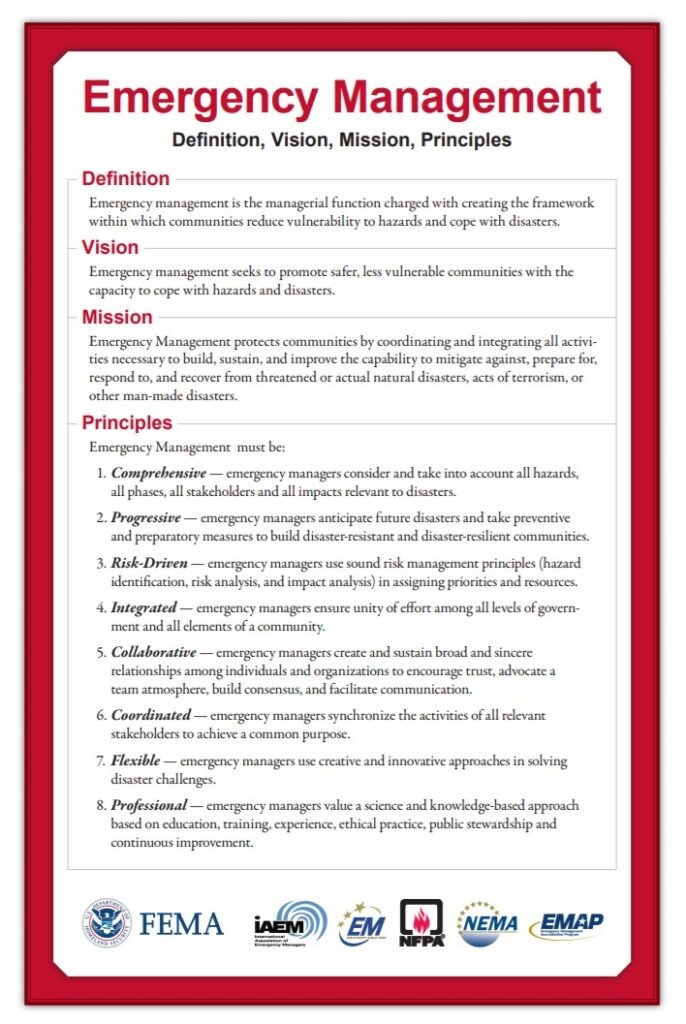
Emergency management is the managerial function charged with creating the framework within which communities reduce vulnerability to hazards and cope with disasters.
Thanks to the support of the Superintendent of the Emergency Management Institute, Dr. Cortez Lawrence, this definition, along with its accompanying mission and vision statements and the Principles of Emergency Management, was formally adopted by FEMA. Shortly thereafter it was also adopted by the International Association of Emergency Managers, the National Emergency Managers Association, the National Fire Protection Association, and the Emergency Management Accreditation Program. You can find a copy of the Principles on my website at https://luciencanton.com/resources/professional-standards/.
It comes as something of a surprise then that in a memorandum released on September 22 titled We Must Return to the Basics: A Definition of Emergency Management and Professional Framework FEMA Director Cameron Hamilton stated that, effective immediately, FEMA would define emergency management as:
“the strategic coordination of emergency services to protect life, property, and continuity of operations.”
It begs the question of whether Hamilton did not do his homework before issuing his memorandum, was poorly served by his staff, or does not care about the opinion of the major emergency management organizations in the United States. Either way, this new definition is a definite step backwards for emergency management.
Compare the two definitions and you’ll see what I mean. The accepted definition created by the POEM working group emphasizes the value that emergency management brings to a community. By focusing on the development of a framework for resilience, it is inclusive, allowing for participation by the whole community. Further, it incorporates the essential development of mitigation and recovery plans. Also, note the specific focus on community vulnerability,
Now compare that with the new FEMA definition. Where the POEM definition takes a strategic approach, the new definition is decidedly operational and focuses strictly on emergency services. I also note that there is no longer any emphasis on protecting the environment, something that has always been a priority for communities, along with life and property. Continuity is an operational issue, not a strategic one. It is also concerning that the 12 Coordination Responsibilities of Emergency Management address only short-term recovery and makes no mention of mitigation beyond the phrase, “reducing risks.”
Why does it set us back rather than helping us move forward? For the longest time, emergency managers were defined by the tasks they were expected to perform in a disaster. However, in actual practice the tasks associated with emergency managers were performed by someone else, either specific agencies or taskforces made up of multiple agencies. It took years for us to realize that emergency managers should be defined not by tasks but by their ability to coordinate the activities of multiple actors. In the world of specialists, emergency managers are the consummate generalists
It took even longer for us to realize that emergency management is not solely about response but must also consider strategic issues like mitigation and recovery. The four-phase Comprehensive Emergency Management Model that forms the foundation of modern emergency management in the United States was introduced by the National Governor’s Association in 1978. However, the 2004 National Emergency Management Baseline Assessment found that only 26% of the states surveyed were conformant for recovery planning, 23% were conformant for mitigation and 14% conformant for continuity planning. This contrasts with 51% conformant for response planning. Partly this was the result of emergency management being considered a “second job” and largely staffed by people with operational backgrounds and experience and limited knowledge of emergency management research.
We have come a long way since those early days. Emergency management is now a recognized academic discipline producing new emergency managers with a strategic perspective. We have an accepted definition of who we are, a set of principles, and a code of ethics. Recovery, mitigation, and recovery plans are now the norm, as is a system of inter-state mutual aid. We still lack a mechanism for limiting access to our field for those without the necessary qualifications and for enforcing our code of ethics, but we are closer than ever to being recognized as a full profession.
Focusing on operational response to the detriment of a strategic approach to the full range emergency management responsibilities takes us back to a time before the introduction of the CEM model in 1978. Worse, it is the mark of a novice emergency manager with limited experience and little understanding of the research that forms our specialized body of knowledge.