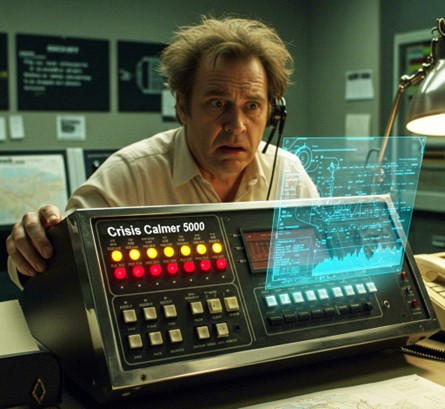
In Technology We Trust
Guest Contribution by Michael Martinet, CEM
Go to a trade show, ANY trade show, and technology vendors of one sort or another, be they physical equipment or digital services, are the dominant presence. Nowhere is this more the case, than at an emergency management, disaster response, terrorism, or crisis management conference.
These cutting-edge technologies, especially including Artificial Intelligence, promise deliverance from whatever shortfalls bedevil the viewer’s respective discipline or program. If there’s a problem, there’s allegedly a technology fix on display, be it faster, more accurate, or more omnisciently able to analyze the respective data.
As is often the case, the individual technology not only promises to provide solutions to both the current perceived problem(s), and whatever unpleasant problems may possibly pop up in the indistinct near future.
Naturally, there is an often-substantial upcharge for these future features, and there is also the matter of the associated training costs, and the annual maintenance fees to maintain the usefulness and viability of the particular product or service in question. Thus, the actual life cycle costs can often be quite indeterminate; especially when the application of the technology turns out to be a spectacular flop.
Twenty or so years ago, in Southern California, during a very large wild fire, a notification technology, as advertised, sent an evacuation warning out to the community via local television, at THREE o’clock in the morning, a brain-dead mis-application of a possibly otherwise useful tool, insofar as almost all of the viewing public would have been asleep at that time.
On the flip side of the coin, the 2018 Hawaii false missile alert sent the Islands into a thoroughly confused status. Approximately one-quarter of the residents believed the alert, and nearly the same fraction did not believe the broadcast, with almost one-half not knowing either way.
An important consideration in the procurement and application of any technology are the inherent promises which the product or system promises to deliver, albeit usually under ideal conditions. Few technological solutions(?) will be able to deliver all that is promised.
Some years ago, I worked with a city of 140,000 population, within a much larger metropolitan area which also had a major petroleum refinery. Thanks to and because of the presence of the refinery, the city had no less than seven different types of notification protocols and technologies, due in part to the unpleasant fact that no single protocol or technology could guarantee 100% notification in the event of a problem at the refinery.
In one instance, when the warning sirens went off, the prevailing winds were blowing opposite from their normal flow, and the sound of the sirens were heard in a neighboring city, where the citizens had no idea what the siren’s warning meant, and naturally the city in which the sirens were located got less than the planned level of warning.
Technology is only a crude tool when mis-applied. It’s using a hammer to cut a board and using a saw to pound a nail.
The key element always is effective, proper, and understanding human control of the technology.
Looking back at the tragic floods that affected Texas this past summer, one of the frequently raised questions was regarding the lack of warning sirens. The sheriff was allegedly asleep, the emergency manager was supposedly off sick, and many of the locals were not concerned in spite of the broadcast warnings. What good would warning sirens have done to bring this picture into sharp actionable focus and actually save lives?
Just weeks earlier, in St. Louis, the responsible parties allegedly failed to use the existing warning siren system when a devastating tornado struck the City. The siren system was, by the way, very old, and apparently ill-maintained, so there’s no way to know if it would have worked, and if so, its warning was believed and acted upon by the citizens.
In the emergency management world, technology often presents the promise of timely and effective warning, often delivering neither. Sometimes indeed it is a failure of the technology itself, but quite often the failure resides in the hands and minds of the human behind the magic button.
Until humans wake up and take serious account of their responsibilities to their citizens will the ephemeral promise of technology begin to be even slightly realized. Signing off on the purchase order for a specific technology is not in and of itself a solution, it is the beginning of a very long-term and serious commitment.
Michael Martinet is Principal with The Martinet Group, LLC, specializing in teaching Disaster Finance and Cost Recovery programs. He is the author of Fighting With FEMA: A Practical Regulations Handbook.