Is Your Emergency Alert Messaging Really Effective?
One of the things I learned in my military service was how to adapt quickly to new unit assignments. This meant learning to adapt to a new corporate culture and new skills. When I joined FEMA in 1990, I was surprised to learn that there was no on-boarding process or initial training. Indeed, it was months before I discovered, quite by accident, the range of sub courses offered by the Emergency Management Institute. I was essentially on my own.
One of my self-assigned projects was to create a small binder with tables and graphs that helped me learn the basics of natural hazard risks. This included such esoterica as the difference between typhoons and hurricanes, and why the Moment Magnitude Scale (Mw) is preferred over the old Richter scale in measuring earthquake magnitude and what the Modified Mercalli Intensity Scale has to do with either. Then there was the difference between flood warnings and alerts, the Enhanced Fujita Scale for measuring tornados, and even NOAA’s space weather scale. I still have that binder somewhere.
My point is that as emergency managers we become familiar a considerable amount of information that is essential to our risk analysis. However, we sometimes forget that when we carry that information over to our emergency alert messaging, we run the risk of obscuring rather than clarifying the message we are trying to convey. In many cases the public either does not understand or care about the information we are providing.
Consider, for example, the use of “alarms” by fire departments in responding to fires. I would submit that the average citizen most likely considers this merely a measurement of magnitude such as one alarm – small or five alarm – very bad. In actual practice each alarm carries with it a specific allocation of apparatus and may even trigger a recall of off-duty personnel. Further, if it’s your house on fire, does the level of alarm even mean anything to you so long as sufficient resources show up?
Another example is the use of flood advisories, watches, and warning. In areas prone to regular flooding, these may be understood but to those not familiar with them it could be confusing.
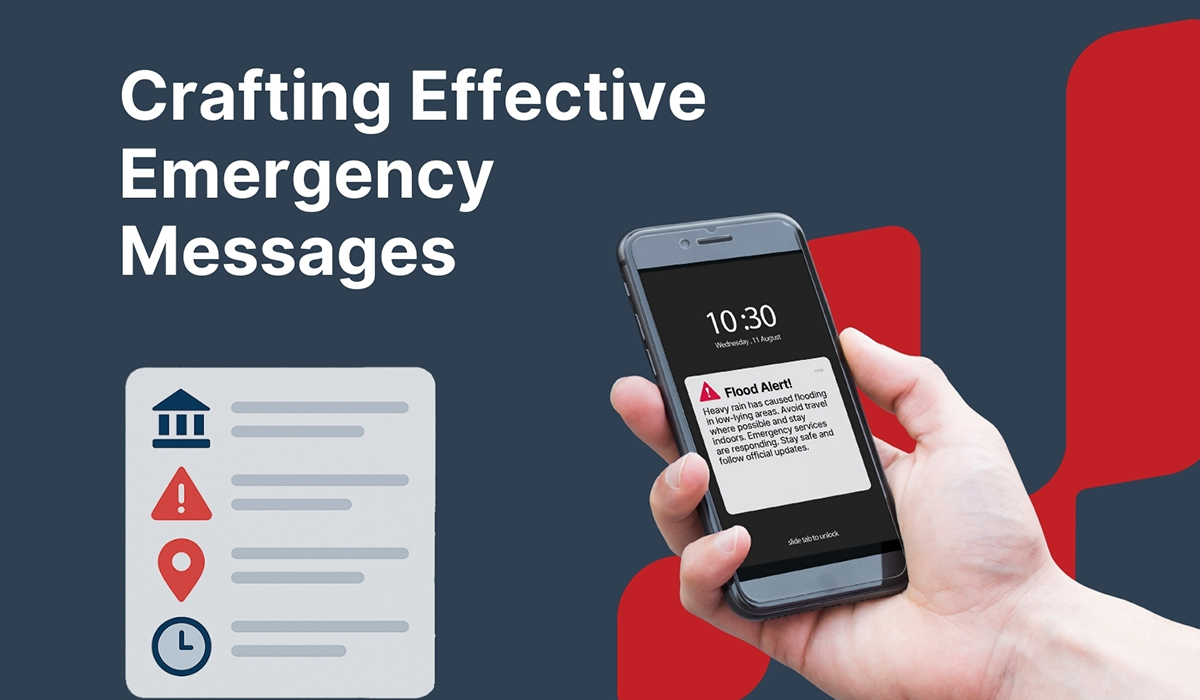
Beyond confusion that may be caused by our use of esoteric terminology, the big problem is that we don’t always craft our message with the listener in mind. It’s easy to forget or overlook that at the time of crisis, the public only wants to hear three things:
- What’s the problem?
- What does this mean to me?
- What do you want me to do about it?
Think back to a lot of public messaging after September 11th. There was a considerable amount of public messaging about potential methods of attack that might be used by terrorists, much of it nonsense such as the use of crop dusters. In almost every case, the problem was identified very vaguely, the risk was never definite about who might be targeted, and the message never included specific actions. The result was an increase in public fear.
The late Dr. Dennis Mileti pointed out that emergency messaging needed to be immediate and specific. He also pointed out that people will not take immediate action on a single message and instead will seek other forms of confirmation through a process sociologists call “milling”. He suggested that effective messaging must include multiple points of dissemination.
Based in Dr. Mileti’s extensive research and my personal experience, I developed the following guidelines for emergency messaging:
- Differentiate between informational and emergency messages.
- Limit the use of emergency of emergency message systems to immediate threats.
- Clearly identify the intended receiver of your emergency message.
- Avoid jargon and use common language in your message.
- Be specific about actions the receiver must take.
- Use multiple points of dissemination.
Consider the difference between the following messages:
There is a four-alarm fire in the downtown commercial area. People in that area should consider evacuating.
There is a large fire in the Johnson Factory Plant on Main Street that is spreading rapidly. People in the area bounded by 4th Street, Market Street, Samson Street, and Rose Avenue should evacuate the area immediately. Emergency shelters have been established at the following locations…
Note the immediacy and specificity of the second message. It clearly targets people in a specific area, explains the risk, and gives them information on what they must do. The first message, however, merely provides information about a fire but lacks the immediacy that would make the recipient act.
There are many other issues that can influence the effectiveness of your emergency messages, such as delays in issuing the message, but the start of a good emergency message is always focusing on the target recipient.