Two Important Developments Affecting Emergency Management
The recently passed 21st Century ROAD to Housing Act has appropriately been lauded as a major step towards affordable housing in the United States. However, the bill includes a significant change to U.S. Department of Housing and Urban Development’s (HUD) Community Development Block Grant Disaster Recovery (CDBG‑DR) that will have an impact on disaster recovery and, for once, it looks like a good thing.
The Community Block Grant is the only federal program for long-term building, and it is often slow due to having to be reauthorized by Congress following each disaster. This often results in long-term delays in starting projects. SEC. 504. Reforming Disaster Recovery Act of the new housing act attempts to correct this problem by making the program permanent. It establishes a standing recovery fund, the Long-Term Disaster Recovery Fund, allowing HUD to immediately provide grant funding after FEMA’s short-term aid finishes.
The act also establishes a dedicated disaster unit within HUD to administer the grant program, the Office of Disaster Management and Resilience. This new office will have responsibility, oversight, and coordination of HUD disaster preparedness and response responsibilities, and for coordinating with FEMA and the Small Business Administration “in supporting recovery and resilience activities to provide a comprehensive approach in working with communities.”
These changes could dramatically increase the speed at which grant funds are provided for local communities. However, there is one fly in the ointment: to satisfy House Republicans, these changes are set to sunset after three years.
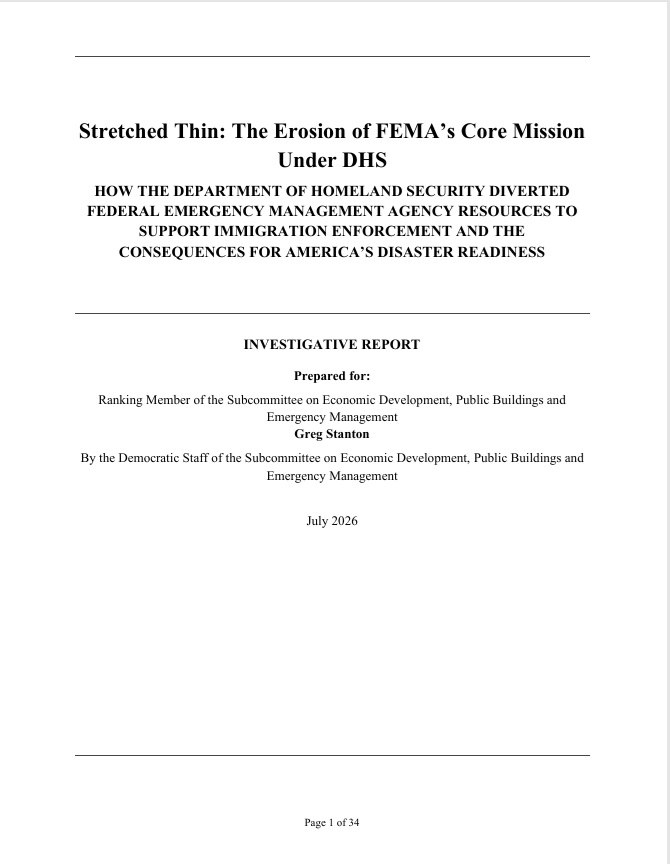
The second important development this month is the release of a report by the Democratic staff of the House Subcommittee on Economic Development, Public Buildings and Emergency Management titled Stretched Thin: The Erosion of FEMA’s Core Mission Under DHS. The subheading summarizes the intent of the report and why it is important reading for emergency managers: How the Department of Homeland Security diverted Federal Emergency Management Agency resources to support immigration enforcement and the consequences for America’s disaster readiness.
Many of us have followed the attempts to dismantle FEMA by reducing the number of employees in the already understaffed agency. We have also reacted to the ethical issues raised by the involvement of the Florida Department of Emergency Management in the establishment and management of the “Alligator Alcatraz” detention center. But the findings of this report document an astonishing level of misuse of FEMA staff and the Disaster Relief Fund (DRF).
Perhaps the most shocking of the fourteen findings detailed in the report was the use of FEMA staff to create the operational backbone for large scale immigration enforcement and detention operations. FEMA assets were also deployed to support operations at detention centers. This included detailing full-time staff and Cadre of On-Call Response/Recovery (CORE) contract employees (who are funded by the DRF) to ICE to support operational planning for arrests, raids, and patrols. In the case of CORE employees, whose contracts were denied under DOGE cuts, employees were offered automatic renewal of their contracts on the condition that they ”volunteer” to work for ICE. There is no evidence of any legal justification for the use of CORE employees in contravention of the Stafford Act or of interagency agreements for reimbursement to the DRF.
Even more concerning was the deployment of FEMA’s National Incident Management Assistance Team (IMAT) to Customs and Border Protection headquarters to support interior immigrations raids. According to FEMA,
“IMATs are full-time, rapid-response teams with dedicated staff able to deploy within two hours and arrive at an incident within 12 hours to support the local incident commander. The teams support the initial establishment of a unified command and provide situational awareness for federal and state decision-makers crucial to determining the level and type of immediate federal support that may be required.”
Deploying IMAT to support a non-humanitarian DHS mission is beyond the scope of FEMA’s mission and the Stafford Act and represents an unprecedented repurposing of a core disaster management asset.
According to a former FEMA employee with working knowledge of FEMA’s National Incident Management Assistance Team – Homeland Security (NIMAT-HS) and field experience at a Texas detention facility:
ICE could not have done this work without FEMA. ICE is good at law enforcement, but operations, strategy, and the big picture—FEMA created that structure for them, building the plan and the operation toward the mission end goal.
There is much more in the report about DHS interference with FEMA’s core mission:
- Misuse of FEMA’s Shelter and Services Program (SSP) to fund detention centers.
- Stifling of innovative approaches to meet survivor needs.
- Curtailment of training and requiring vetting and certification of the immigration status of foreign nationals undergoing training under grant programs.
- Presidential declarations of disaster favoring states politically aligned with the President.
The conclusion of subcommittee is devastating:
The findings of this investigation reveal deliberate policy choices at the White House and Department of Homeland Security have systematically redirected FEMA away from its statutory mission.
In response, the report made eight common sense recommendations:
Recommendation 1: Resume hiring FEMA employees to enable the agency to meet its staffing targets.
Recommendation 2: Resume all training programs to ensure FEMA, state and local emergency managers, first responders and Tribal nations are prepared to respond to disasters.
Recommendation 3: Continue oversight of the presidential disaster declaration process and draft legislation to require an increase in the pace of responses to declaration requests, establish stronger oversight mechanisms and reduce politicization of FEMA assistance.
Recommendation 4: Recall all FEMA employees detailed to ICE and CBP to ensure FEMA’s disaster readiness.
Recommendation 5: Establish FEMA as an independent agency to prevent the diversion of FEMA personnel to immigration enforcement missions.
Recommendation 6: Direct CBP and ICE to reimburse FEMA for all costs incurred in support of immigration enforcement operations.
Recommendation 7: Conduct further analysis of the impact of 287(g) expansion on local emergency management capacity and the willingness of immigrant communities to engage with disaster preparedness and response programs.
Recommendation 8: Amend the Post Katrina Emergency Management Reform Act to create penalties if a President or the Secretary of an outside Agency or Department directs FEMA to do work that undermines FEMA’s primary mission.
With several bills intended to reform FEMA before Congress, this report is both timely and informative. I believe this report should be required reading for emergency managers and used to help spark legislative change.