The FEMA Review Council Report: Does It Really Change Anything?
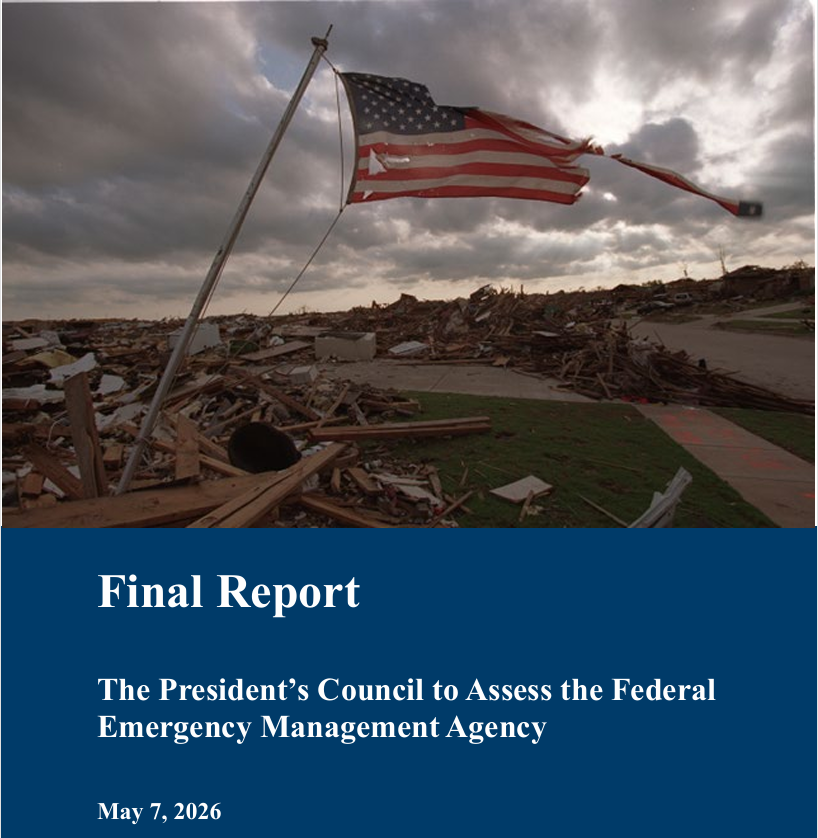
The final report of the FEMA Review Council was accepted and released on May 7th at the Council’s final meeting. You can read the 75-page report here or a see a summary presentation here. The report contains ten recommendations for improving FEMA. I do not intend to summarize and critic the recommendations. For that I refer you to a remarkable post by Craig Fugate: The President’s Council to Assess the Federal Emergency Management Agency, May 7, 2026 — Final Draft. Instead, I’ll focus on some specific issues raised by the report and, more importantly, some of the things it fails to address.
My first reaction to reading the report was to ask, “so what?” The document creates a new mantra for response in the United States, “Locally executed, state managed, federally supported.” Catchy and I’m sure we’ll be hearing it repeatedly, ad nauseum. This is emergency management 101 and has always been how we approach disaster. I’m convinced that the claims that FEMA “takes over” has more to do with congressionally mandated federal regulations than with on-site decision making.
In over seven years with FEMA, I participated in over sixteen disasters from the Pacific to the Caribbean and from Georgia to New York and never experienced any attempt to circumvent the state we were supporting. The whole concept of the Joint Field Office is to provide “a central location for coordination of Federal, State, local, tribal, nongovernmental and private-sector organizations with primary responsibility for activities associated with threat response and incident support.” Did I observe conflicts between state and federal officials? Of course. But these were settled through negotiation not circumvention.
I think that the report conflates federal control with another issue: the overreliance on states and local governments on the federal government to provide disaster relief. In the 1950’s, the US had around 20 disaster declarations for year. By 2024, the total disaster declarations had increased to 108. There are certainly other reasons for the increase, notably climate change, legislation that increased eligibility, and the increasingly low rate of denial. But the ease in which disaster declarations can be obtained creates the incentive for governors to request disaster declarations rather than invest in preparedness.
The report recommends reducing this incentive by realigning the criteria for federal relief, specifically the Per Capita Indicator, and using the level of severity for public assistance and individual assistance funding. I’ve always been uncomfortable with determining disaster relief solely on cost without considering other factors that affect a community.
And speaking of disaster relief funding, the report recommends major changes to the individual and public assistance programs. The individual assistance program would replace multiple programs with a single direct payment to survivors while transferring responsibility for immediate sheltering to state, local, and tribal governments. Last time I checked, this was already the responsibility of these levels of government. FEMA would focus on temporary housing but only for “Americans (emphasis mine) whose homes are uninhabitable.” The report also recommends homeowner assistance be based at no more than 15% of the local government’s assessed value, capped at $150,000.
For public assistance the report recommends eliminating loss assessments and using a parametric trigger, a concept where if an event reaches a pre-defined threshold, it automatically sets the immediate payment amount based on the magnitude of the event. In other words, pay the state for what we think might have been damaged rather than what was damaged.
There’s lot more but this points out one of the major problems with this report: it’s all about the money. While some of the recommendations mirror ones that have been made multiple times and are worth considering. There is nothing in it that gets at root causes of disasters. Indeed, the report recommends eliminating the Hazard Mitigation Grant Program in favor of rapid post-disaster funding, ignoring the pre-disaster mitigation funding that was the cornerstone of James Lee Witt’s reforms. The recommendations for the Individual Assistance Program’s homeowner’s assistance would continue the problems that research has shown prevent rebuilding in economically disadvantaged neighborhoods. The emphasis on providing relief only to “Americans” is also a red flag.
Something else that is missing is the actual implementation of the recommendations. Page 15 of the report notes that seven of the ten regulations require legislation or changes to regulations to implement, yet no mention is made of existing legislation already proposed in Congress, particularly H.R. 4669 The Fixing Emergency Management for Americans Act of 2025 which addresses many of the problems noted in the report.
Another omission is the fate of FEMA. Despite considerable support from the public and the emergency management community, Recommendation 10 casts severe doubt about FEMA’s continued existence:
It is time to close the chapter on FEMA. “FEMA” as a brand and as an agency was irreparably damaged by the previous Administration’s proclivity to mission creep and endemic program failures. A transformed agency should be established that retains the core missions of EMA, while highlighting the renewed emphasis on locally executed, state or tribally managed, and federally supported emergency management.
The recommendations of the Council are not all bad. Indeed, they reflect many of the concerns long expressed by the emergency management community and some of the solutions have merit. However, the report reflects a focus on finance and cost savings. It does reflect a concern for reducing future disasters or truly improving relief for disaster survivors. It does not address the concerns of the emergency management community. It’s just another wish list, made with good intentions, but most likely doomed to produce little beyond minor cosmetic change.